
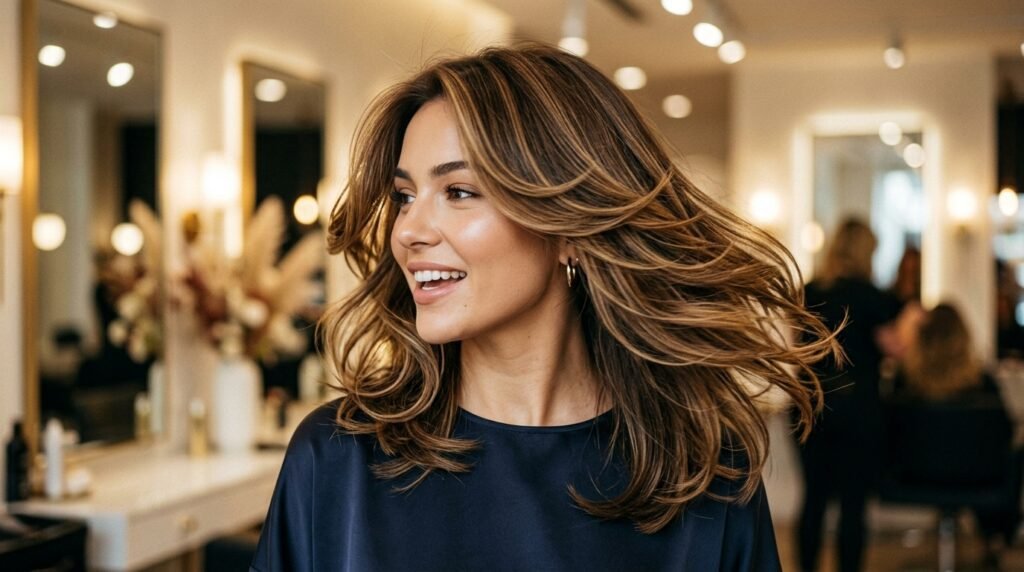

“Should I get Layered Hair?” is the most asked question in every salon — and the answer is always the same frustrating “it depends.”
It depends on nothing the client can control — the consultation moves to face shapes, hair textures, and lifestyle questions that the client has never heard connected to layers before. And the client leaves either with layers that transform her hair or with layers she didn’t need, and the difference was the information the stylist assumed she had.
Here is the decode the salon consultation skips: “layers” is not one thing — it is a family of six cutting techniques, each doing different things for different hair. Face-framing layers do one job. Internal layers do another. The layer that transforms fine hair is not the layer that helps thick hair, and the layer that flatters a round face is wrong for a long one.
So this guide explains every layer type — what each layer actually does, which hair types and face shapes each one serves, and the maintenance reality of each. Read it before the salon, and the “it depends” becomes a specific answer with your name on it.
The layers were never confusing. They were just never explained.
Follow our Pinterest boards for daily haircut inspiration, and join us on Facebook so you never miss a cut guide.
The Six Layer Types (The Family, Decoded)

Every layer in the salon is one of six techniques — and each technique does a different job.
The six: face-framing layers, internal layers, long layers, short layers, curtain layers, and the invisible layers. Each cut sits at a different depth, does a different job, and suits a different head.
The layer that transformed your friend’s hair might be the wrong layer for yours — not because the technique failed, but because the technique was solving a different problem.
1. Face-Framing Layers — The Face Sculptor

The layers cut specifically around the face — shorter pieces at the front that frame the face like a picture frame frames art.
What it does: draws attention to the face, softens strong jawlines, adds dimension beside the cheeks, and creates the “face lifted” effect without touching the length behind.
Best for: every face shape — the placement adjusts per face. Round faces get longer face-frames that elongate; square faces get softer face-frames that soften the jaw; long faces get fuller face-frames that add width.
The maintenance: the face-frame grows out fastest — the pieces near the face need refreshing every six to eight weeks while the rest of the cut holds longer. The face-frame is the highest-maintenance layer and the most visible.
The pairing: the face-framing layers pair with the butterfly cut from our butterfly haircut guide — the butterfly is essentially face-framing layers taken to their fullest expression.
2. Internal Layers — The Volume Builder

The layers cut inside the hair — invisible when the hair is flat, revealed when the hair moves. The layers that create volume without changing the outer shape.
What it does: removes internal weight so the hair lifts at the roots and moves at the mid-lengths — the volume that fine and flat hair cannot build on its own.
Best for: fine hair, flat hair, and anyone whose hair reads “heavy” or “limp” — the internal layers are the fine hair’s best friend. The volume boost that our best haircuts for thin hair guide recommends first.
The maintenance: the lowest — internal layers grow out invisibly because they live inside the cut. The lowest-maintenance layer with the highest daily impact.
The trick: internal layers need the blow-dry or the diffuser to reveal themselves — air-dried flat hair hides the internal work. The round-brush blowout is the internal layer’s activation switch.
3. Long Layers — The Movement Keeper

The layers cut throughout the length but keeping the ends long — the layers that add movement to long hair without sacrificing any significant length.
What it does: gives long hair movement, prevents the one-length heaviness, and lets waves and curls read more defined. The layer that keeps the length while adding the life.
Best for: long hair that reads heavy or one-dimensional, wavy hair that wants more bounce, and anyone growing their hair out who wants shape during the growth.
The maintenance: every three months — long layers grow out into longer layers gracefully, and the grow-out phase never reads awkward. The layer with the gentlest grow-out curve.
The pairing: long layers pair with every styling from our long hair guide — the superpowers need the layers to read at full strength.
4. Short Layers — The Volume Statement

The layers cut short throughout — the shag-style layers that create maximum volume and texture. The boldest layer commitment.
What it does: creates serious volume, texture, and movement throughout — the layers that transform flat hair into voluminous hair, and thick hair into managed texture.
Best for: thick hair that needs the weight removed, 2C wavy hair that wants the layers to organize the pattern, and the shag-wanting heads. The short layers from our short haircuts 2026 guide’s shag builds.
The maintenance: every six to eight weeks — short layers grow out visibly and need the rhythm maintained. The boldest layer with the most regular schedule.
The caution: short layers on fine hair read thin — the fine-haired should stay in internal and face-framing territory. The layer must match the hair’s density.
5. Curtain Layers — The Face-Frame’s Softer Sibling

The layers cut in curtain-bang style around the face — softer than face-framing layers, framing without the shorter commitment.
What it does: frames the face with soft, longer pieces that blend into the length — the face-framing effect with a gentler grow-out.
Best for: every face shape with the placement adjusted, wavy hair that the curtain pieces organize naturally, and anyone who wants the face-framing effect with less maintenance.
The maintenance: every ten weeks — the curtain layers grow out into face-framing layers, which grow into the length — the gentlest grow-out ladder of any layer type.
The pairing: curtain layers pair with the middle parts and the curtain-bang energy — the soft frame that the clean-girl aesthetic wears with everything.
6. Invisible Layers — The Seamless Volume

The layers cut so finely they are invisible when the hair is down — the layers that add movement and body without reading as “layers” at all.
What it does: adds the internal movement and the subtle dimension without any visible layer lines — the layers for the women who “don’t want to see layers.”
Best for: fine to medium hair, the professional settings that read visible layers as too styled, and anyone who wants the benefits without the look.
The maintenance: every twelve weeks — the invisible layers hold longest and grow out most seamlessly. The lowest-visibility layer with the longest schedule.
The trick: invisible layers need the blowout to reveal — the air-dried invisible layer reads like no layer at all. The activation is the styling, same as the internal layers.
The Layer-and-Face-Shape Map (The Quick Match)

The face shapes matched to their layers — the one-page answer.
Round face: face-framing layers starting at the cheekbone, long layers for the elongation, curtain layers for the vertical frame. The vertical layers elongate round faces. More on this in our best haircut for round face guide.
Oval face: every layer works — the oval is the universal face. Experiment freely.
Square face: curtain layers and soft face-frames — the layers that soften the jaw. Avoid blunt, short layers that add width at the jaw.
Heart face: face-framing layers at the chin — the volume that fills below the cheekbones. The chin-length face-frame balances the wider forehead.
Long face: curtain layers and short face-frames — the width-adding layers. Avoid the long vertical layers that elongate further.
The complete face-shape guide lives in our best haircut for your face shape guide — this layer map is its layer-specific chapter.
The Layer-and-Texture Map (The Second Match)

The hair texture matched to its layers — the second half of the decision.
Fine hair: internal layers and invisible layers only — the layers that build volume without thinning. Short layers on fine hair read thinner — the density rule.
Medium hair: every layer works — the texture that carries all six techniques comfortably.
Thick hair: short layers, long layers, and the internal thinning — the layers that remove the weight thick hair carries. The density that needs the management.
Curly hair: face-framing and long layers, cut dry by a curl specialist — the layers that follow the curl pattern. The wet-cut layers on curly hair are the gamble that reads wrong.
Wavy hair: every layer works, with the long and curtain layers reading most effortless. The wave texture from our wavy hair guide layers naturally.
Layered Hair FAQ
What do layers do for your hair?
Layers remove weight from inside the cut, add movement to flat sections, frame the face with shorter pieces, and create the volume that one-length hair cannot build. Each layer type does a different job — face-framing layers sculpt the face, internal layers build volume, and long layers add movement to the length.
What is the difference between face-framing layers and regular layers?
The placement — face-framing layers are cut specifically around the face to frame it, while regular layers (internal, long, short) are cut throughout the hair for volume, movement, and weight removal. Face-framing is the most visible layer and needs the most frequent refreshing.
Do layers make thin hair look thinner?
The wrong layers do — short layers on fine hair read thinner by removing visible density. The right layers for thin hair are internal and invisible — the layers that build volume without cutting visible density. The layer must match the hair’s thickness.
How often do layers need to be cut?
Face-framing layers every six to eight weeks, short layers every six to eight weeks, long layers every three months, and invisible layers every twelve weeks. The layer type decides the schedule — the more visible the layer, the more frequent the refresh.
Can you add layers to hair without cutting it shorter?
Yes — internal layers and invisible layers remove weight and add movement without changing the visible length. The perimeter stays intact while the inside gets the layering — the layer that adds dimension without sacrificing length.
More questions? Ask us on Facebook and we will match a layer to your hair type and your face shape.

Want an edgier layered look? The wolf cut hairstyles is still one of the most requested cuts in salons this year.
The “It Depends” Was Always a Map
Six layer types, the face-shape map, and the texture match that completes the decode — layered hair stops being “it depends” the moment the layer family gets explained.
Identify your hair type and face shape tonight. Read the layer that matches both. And the next salon visit, ask for the layer by name — the consultation that “depends” becomes the consultation that knows.
Save this decoder to our Pinterest boards so it travels to every appointment, and pair the layers with the cuts they live in from our medium length haircuts 2026 guide and the butterfly haircut guide — the layers decoded, the cuts connected.
New cut guides every week. Stay layered, stay decoded! ✂️




[…] it suits: everyone — the most forgiving construction on the chart. The full logic in our layered hair […]
[…] Match: 2C–3B — patterns long enough to show the layer’s work. The layer logic decodes in our layered hair guide. Style It: style in four sections — never attempt the whole head at once — and diffuse […]
[…] buttery caramel slices through the mid-lengths give dark bases instant dimension, especially on layered hair where every ribbon gets its own highlight. The tone sits between gold and toffee, so it warms cool […]