
Dress styles are chosen by the occasion — not by color, not by trend, and never by accident.
Every closet holds one dress that works and a dozen that almost did. The occasion arrives, the options come out, and nothing reads exactly right — because dress shopping keeps happening by beauty instead of by occasion, and the occasion is what actually decides everything.
Here is the reframe that changes dress shopping forever: dresses are not chosen by color or trend first — they are chosen by the event. The venue, the hour, the formality, the season — these decide which silhouettes work, which fabrics read right, and which lengths photograph correctly. The dress that stuns at a wedding reads confused at a brunch.
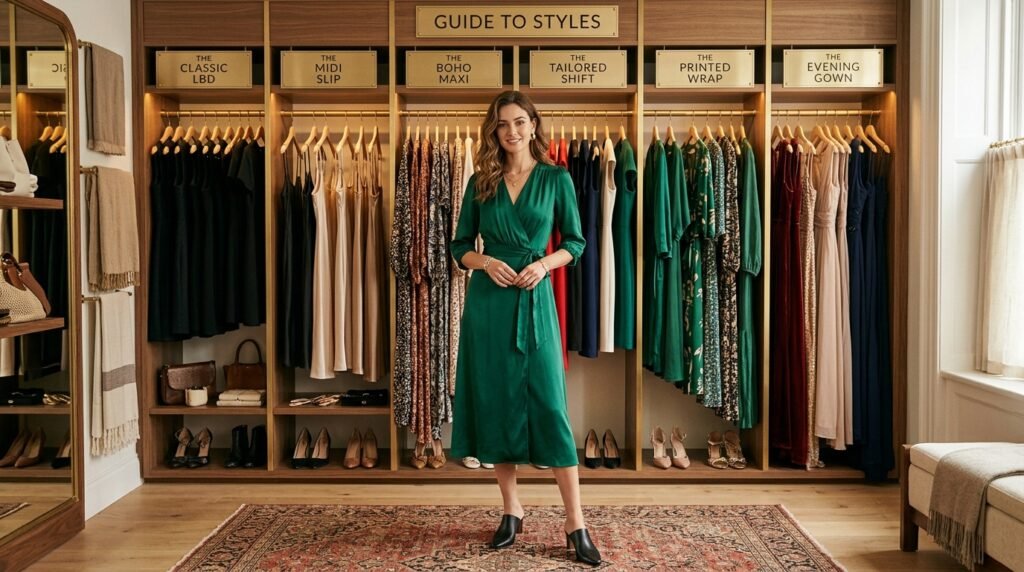
So this guide is the occasion map — thirty dress styles organized by the events that need them. Day dresses, work dresses, party dresses, wedding-guest dresses, and the little black dress that crosses all of them. Each style with its occasion, its styling, and the reason it works.
Your calendar has the occasions. The map has the dresses.
Follow our Pinterest boards for daily dress inspiration, and join us on Facebook so you never miss a style guide.
The Occasion Map — How This Guide Works

Thirty dresses, six occasion families — the navigation system for every event on the calendar.
The six occasion families: Everyday Casual, Work and Office, Evening and Party, Weddings and Formal, Date Night, and Resort and Vacation. Each family gets its dress styles, its length logic, and its styling rules.
The cross-referencing secret: many dresses belong to two families — the wrap dress works at brunch and at dinner, the slip dress at parties and date nights. The guide notes the crossovers, because the best dress wardrobe is built on the pieces that do double duty. The same double-duty logic from our fall capsule wardrobe 2026 guide runs this map.
Occasion 1 — Everyday Casual
The dresses that work at brunch, errands, markets, and every no-reason outing — comfort-first, style-always.
1. The T-Shirt Dress

The jersey t-shirt dress — the throw-on dress that reads styled with the right accessories. Sneakers and a crossbody for errands; a belt and boots for brunch.
Why it works: one garment, zero decisions, infinite accessories. The t-shirt dress is the casual dress that earns its closet slot through pure frequency.
The upgrade move: the belt or front-tuck from our guide on how to style oversized sweaters — the waist definition that turns basic into intentional.
2. The Denim Dress

The chambray or denim dress — shirt-dress energy in denim’s durability. Button-front, belt it, or wear it open over a tee — the denim dress is three outfits in one garment.
Why it works: denim dresses transition across seasons — bare-legged in summer, with tights and boots in winter. The dress with the longest working year.
3. The Smock or Tiered Dress
The loose, tiered dress — flowy, forgiving, and endlessly comfortable. The dress that suits every body by refusing to touch anything tightly.
Why it works: the tiered shape skims without clinging, and the volume reads deliberate rather than oversized when the sleeves and hem stay proportioned.
4. The Polo Dress
The collar dress — sporty, clean, and the athleisure-crossover dress that reads put-together at school runs and casual lunches alike.
Why it works: the collar adds the structure that t-shirt dresses lack — the half-step dressier, at the same comfort level.
Occasion 2 — Work and Office
The dresses that survive office air conditioning, read professional in meetings, and never cross the too-casual line.
5. The Sheath Dress

The structured column — the office dress classic. Skims the body, ends at the knee, reads professional in every industry from finance to creative.
Why it works: the sheath’s clean lines read competent, and the structured fabric holds its shape through every meeting. The office dress that photographs professionally in every work context.
6. The Tailored Shirt Dress
The crisp button-front dress — the shirt-dress’s formal sibling in poplin or silk-blend. Belted or straight, it reads office-appropriate in every professional setting.
Why it works: the collar and buttons carry the professionalism; the dress format carries the comfort. The work dress that never reads try-hard.
The crossover: this tailored shirt-dress moves to brunch and errands with sneakers — the work-to-weekend piece that our capsule wardrobe guide’s philosophy rewards.
7. The Wrap Dress
The wrap silhouette — the universally flattering dress that adjusts to the body exactly. Office-appropriate in structured fabrics, defined at the waist, and comfortable through the longest workdays.
Why it works: the wrap is adjustable architecture — the fit control no fixed-size dress offers, reading tailored on every body. The same wrap logic that anchors our plus size thanksgiving outfit guide’s formal looks.
8. The Knit Midi Dress

The ribbed or fine-knit midi — the sweater-dress’s office cousin in polished knits. Long sleeves, defined waist, and the warmth that office air conditioning demands.
Why it works: knit midi dresses read professional in creative and business-casual offices while being the most comfortable dress in the work rotation. Pair with the boot formulas from our thanksgiving boots outfit ideas guide.
Occasion 3 — Evening and Party
The dresses that carry the night — cocktail parties, birthdays, holiday events, and every celebration that starts after six.
9. The Little Black Dress

The LBD — fashion’s permanent answer to every evening invitation. The cut varies; the function never does.
Why it works: black photographs sharpest, flatters longest, and accessorizes into any party’s mood. The dress that has never once been the wrong answer. The all-black styling with one statement — the formula from our guide on how to look expensive on a budget.
10. The Sequin Dress

The all-over sparkle — the dress that IS the party. Mini or midi, in gold, silver, or the season’s it-shades.
Why it works: sequins need no accessories, no jewelry decisions, no styling effort — the dress does the celebration alone. The restraint rule: sequins mean quiet everything else.
11. The Slip Dress
The satin column — the nineties silhouette that reads elegant, modern, and endlessly layerable. Under blazers in winter, alone in summer.
Why it works: the slip dresses up and down better than any dress — blazer for the office party, cardigan for the casual one, alone for the glamorous one. The three-occasion dress.
12. The One-Shoulder Dress
The asymmetric statement — one shoulder bared, the diagonal line that reads fashion-forward in every event photo.
Why it works: the asymmetry is the interest — no necklace needed, no jewelry negotiation. The neckline that photographs dynamically from every angle.
13. The Velvet Dress

The winter party dress — velvet’s dimensional glow in the season’s richest shades. Burgundy, emerald, navy — the fabrics that candlelight was invented for.
Why it works: velvet photographs like luxury at every size and reads seasonal in every December room. The texture that does what sequins do, quietly. The fabric story continues in our christmas velvet nail finish guide.
Occasion 4 — Weddings and Formal
The dresses for someone else’s big day — the etiquette-heavy category where the couple’s day outranks the outfit.
14. The Midi Wrap Dress (Wedding Guest)
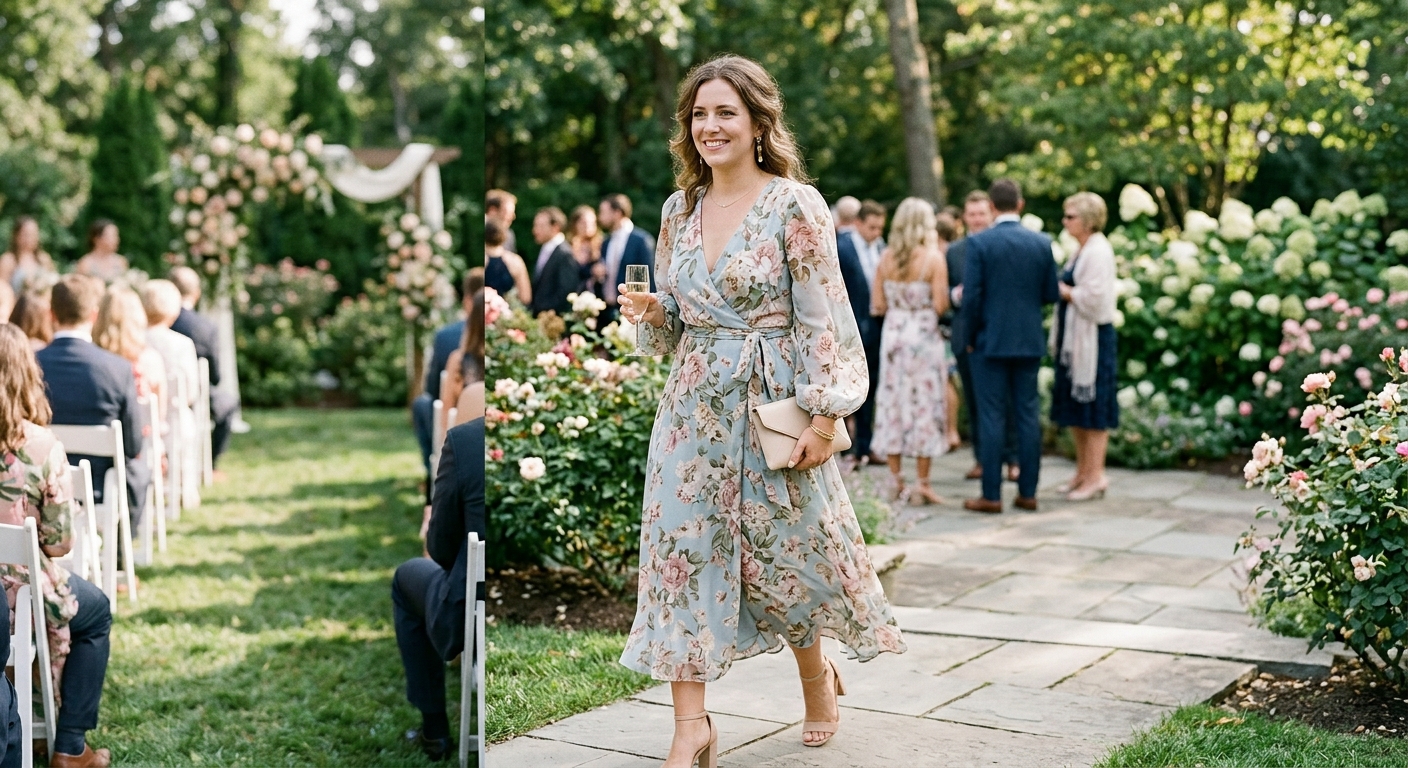
The flowing midi in soft prints or solid jewel tones — the wedding-guest workhorse that photographs beautifully and survives long receptions.
Why it works: the wrap adjusts through hours of sitting and standing, the midi reads appropriate in every venue, and the print or jewel tone avoids the white-line. The full guest-dress etiquette lives in our wedding guest dress ideas guide.
15. The Tea-Length Dress
The hem that stops mid-calf — the vintage silhouette that reads formal without reading bridal. Retro-charming at garden weddings and daytime ceremonies.
Why it works: the tea length reads intentional-formal in daylight venues, and the hem shows the shoes — the pairing detail that daytime weddings reward.
16. The Formal Maxi Dress
The floor-skimming maxi in elevated fabrics — silk, chiffon, or structured crepe. The evening-wedding and black-tie-optional dress.
Why it works: the maxi reads formal through fabric, not length alone — the elevated materials are what separate the evening maxi from the beach maxi.
17. The Cocktail Dress with Detail
The knee-length dress with the structural detail — draping, a bow, an asymmetric hem. The detail is the formality signal.
Why it works: the detail reads effort, which is what wedding guests owe the couple. The simple dress plus the one structural moment is the guest formula that never reads too much.
Occasion 5 — Date Night
The dresses that read romantic, confident, and photographed — the dinner-and-everything-after category.
18. The Bodycon Midi
The fitted midi — the silhouette that reads confident in the right fabric. Ribbed knits and thicker materials do the bodycon correctly; thin jersey does not.
Why it works: the midi bodycon in structured fabric reads sleek rather than tight — the fabric is what keeps the silhouette elegant.
19. The Off-Shoulder Dress

The shoulder-baring romantic — the neckline that reads date-night in every silhouette from mini to maxi.
Why it works: the off-shoulder balances the collarbones and the neckline — the romantic framing that photographs beautifully in restaurant light.
20. The Mini Dress with Tights
The playful mini over opaque tights with boots — the date-night formula for the colder months that keeps the silhouette and adds the season.
Why it works: the tights make the mini winter-appropriate, and the boots ground the look — the pairing that lets the mini dress work twelve months a year.
21. The Wrap Dress (Date Version)
The wrap dress in a romantic shade — blush, wine, or black — the adjustable silhouette for the dinner where confidence matters.
Why it works: the wrap flatters through the sitting-and-standing of dinner dates, and the neckline frames every restaurant candlelight photo.
Occasion 6 — Resort and Vacation
The dresses for the trips — packable, versatile, and photogenic in every destination light.
22. The Flowy Maxi
The flowy vacation maxi — the dress that packs rolled, wears wrinkled-gracefully, and photographs in every golden hour.
Why it works: the vacation maxi does beach days, dinners, and the walk between — one garment, the whole resort day. The packability from our travel capsule wardrobe guide’s philosophy.
23. The Linen Dress

The linen midi or mini — the breathable, textured, effortlessly-expensive vacation dress. Wrinkles read as texture in linen; that is the deal and the charm.
Why it works: linen handles heat that other fabrics surrender to, and the natural crinkle photographs as lived-in luxury.
24. The Sundress

The light cotton or rayon sundress — the straps-and-flow dress of the warmest days. Spaghetti straps, smocked bodices, and the prints of the season.
Why it works: the sundress is the heat’s official uniform — minimal fabric, maximum airflow, and the easiest packing item in the bag.
25. The Beach Shirt Dress
The cotton shirt-dress as the beach cover-up, the market dress, and the dinner cover — the vacation’s hardest-working piece in its most casual form.
Why it works: the vacation shirt-dress layers over swimwear and stands alone at dinner — the double-duty that light packing demands.
Occasion 7 — The Crossover Queens

The five dresses that work everywhere — the wardrobe’s real MVPs.
26. The Wrap Dress (The Universal)
The wrap dress crosses casual, work, weddings, and date nights — the one dress that appears in every occasion family on this map.
Why it rules: the adjustable fit reads appropriate everywhere, and the styling changes the occasion — boots and a cardigan for day, heels and jewelry for night. The universal dress earns the closet’s most valuable hanger.
27. The Slip Dress (The Three-Face)
Slip under blazer = work party. Slip with boots = date night. Slip with sneakers and denim = brunch. The slip’s three faces make it the crossover champion of the evening families.
28. The Shirt Dress (The Two Worlds)
Tailored for work, relaxed for weekends — the shirt-dress straddles the office-casual line better than any dress, and the belt decides which side it lands on.
29. The Ribbed Midi Bodycon
Office with a blazer, date night alone, brunch with sneakers — the ribbed midi bodycon reads appropriate in all three because the fabric reads polished in all three.
30. The Little Black Dress (The Eternal)
The LBD crosses every family — office with a jacket, weddings with the right accessories, parties as-is, date nights with the red lip. The dress that has attended every occasion since Coco Chanel invented the concept. The full LBD styling logic appears across our christmas eve dress ideas and thanksgiving outfits guides — the eternal dress in every season’s editions.
The Length Decoder — Mini, Midi, Maxi by Occasion

The length decision is the occasion decision — the quick table.
Mini reads casual, young, and party-forward — right for weekends, dates, and dance floors; wrong for offices and formal weddings.
Midi reads the universal — professional enough for work, dressy enough for events, the length that every occasion accepts. The midi is the safe hem of the dress world.
Maxi reads formal when elevated, casual when relaxed — the fabric decides which maxi the occasion is getting.
The sitting test: the final length check happens seated — every dress looks shorter sitting down, and the occasion-appropriate length is the seated one. Sit before you buy.
Dress Style FAQ
What are the main dress styles every woman should own?
The core five: one casual (t-shirt or denim dress), one work (sheath or wrap), one evening (LBD or slip), one wedding-guest (midi wrap or cocktail), and one crossover (the wrap dress that does everything). Five dresses cover an entire year of occasions.
What dress style is most flattering?
The wrap dress is the honest answer — the adjustable waist definition flatters every body type genuinely, and the silhouette reads tailored on every frame. The same verdict from every fitting room that has ever hosted one.
How do I choose a dress for an occasion?
Match the dress to three occasion factors — the formality, the venue, and the hour. Formality decides the fabric and detail, the venue decides the silhouette, and the hour decides the color depth. The dress that passes all three is the right dress.
What is the difference between a sheath and a shift dress?
The waist — sheath dresses follow the body’s natural waist and curves; shift dresses hang straight from the shoulders ignoring the waist entirely. Sheath reads structured; shift reads relaxed.
What dress styles work for both work and weekends?
The crossover queens — wrap dresses, tailored shirt-dresses, knit midis, and ribbed bodycons. Each reads office-appropriate with structured layers and weekend-ready with sneakers, the double-duty pieces that capsule wardrobes are built on.
More questions? Ask us on Facebook and we will match a dress to the next occasion on your calendar.

The Calendar Decides the Dress
Thirty styles, six occasion families, and the crossover queens that do the work of ten — the dress style guide by occasion turns closet decisions into a map you can read at a glance.
Find the next occasion on your calendar. Read its family. Pull its dress. And the morning panic that used to precede every event becomes the two minutes it should have been all along.
Save this map to our Pinterest boards so it is on your phone for every invitation, and pair the dresses with the capsule logic in our fall capsule wardrobe 2026 guide and the wedding guest dress ideas for the weddings ahead — every occasion, one guide.
New dress guides every week. Stay mapped, stay styled! 👗