Thanksgiving Plaid Nail Art = Your Favorite Flannel, in Miniature

Every November, somewhere in your closet, a flannel shirt starts its seasonal comeback — and this year, your nails want the same thing.
Plaid has always been November’s uniform. It shows up on the blanket over your legs during the parade, the table runner your aunt sets out, the flannel you reach for every cold morning. So when nail artists started painting tiny tartan across manicures, the reaction everywhere was the same: finally — the coziest pattern of the season, in the place you look at most.
The best part that surprises everyone: plaid nail art is one of the easiest “detailed-looking” designs in existence. It is built entirely from straight lines — no drawing talent, no freehand curves, no art degree. Three strokes per direction and the pattern appears.
So this guide unpacks thanksgiving plaid nails in four styles — classic tartan, buffalo check, gingham, and blanket plaid — each with the exact line placement, the coat-friendly color combos, and the two tools that decide whether yours looks boutique or homemade.
Your flannel called. It wants a matching manicure.
Follow our Pinterest boards for daily nail inspiration, and join us on Facebook so you never miss a seasonal design guide.
Why Plaid Nails Own Thanksgiving

Three reasons this pattern dominates the season’s nail searches.
Plaid IS the holiday’s visual language. Thanksgiving tables run on texture — plaid runners, flannel napkins, wool coats arriving at the door. Plaid nails are the manicure that matches the room, which is why family photos with plaid details read coordinated without anyone trying.
It hides imperfection beautifully. Every line in plaid is supposed to cross other lines. A wobbly stripe disappears into the pattern — the exact opposite of chrome or solid colors where flaws scream. Beginners produce their best work in plaid because the pattern forgives everything.
It pairs with everything you will wear. Plaid nails flatter every Thanksgiving outfit from our thanksgiving outfits guide — they echo the flannel, complement the cream knits, and hold their own next to velvet. Very few nail designs claim that range.
The 4 Plaid Styles (They Are Not All the Same)

“Plaid” is a family — and picking your style first decides everything about the manicure.
Buffalo check — big bold squares, two colors only. The lumberjack flannel look. The boldest and easiest.
Classic tartan — the Scottish pattern: a base color, one wide stripe set, one thin pinstripe set crossing it. The most traditional and most detailed.
Gingham — the picnic-blanket check: evenly spaced thin lines both directions. The lightest, sweetest, most beginner-friendly version.
Blanket plaid — oversized, cozy, slightly irregular — the pattern of the actual wool blanket on your couch. The artistic version.
Each style below gets its full build. Pick by personality: buffalo check for the bold, tartan for the traditionalist, gingham for the beginner, blanket plaid for the artist.
The Tool Reality: What Plaid Actually Requires

The honest kit — smaller than you think.
The pro tool: one thin striper brush — the single purchase that upgrades every design in this guide. The free alternative: a toothpick works for every line here, just slower. The cheat code: striping tape — lay it, paint over it, peel it, and every line comes out ruler-straight.
Plus: your base color, one or two stripe colors, a fine dotting tool or toothpick for tartan’s accents, and topcoat.
That is genuinely the whole kit — most of it already in a drawer somewhere. The technique notes in our how to apply nail polish guide cover the thin-coat discipline that plaid demands: every line dries faster and stays sharper when the coats stay thin.
Style 1: Buffalo Check — The Bold Classic

The lumberjack pattern: bold squares in two colors, built from wide stripes crossing wide stripes. Thanksgiving’s strongest statement plaid.
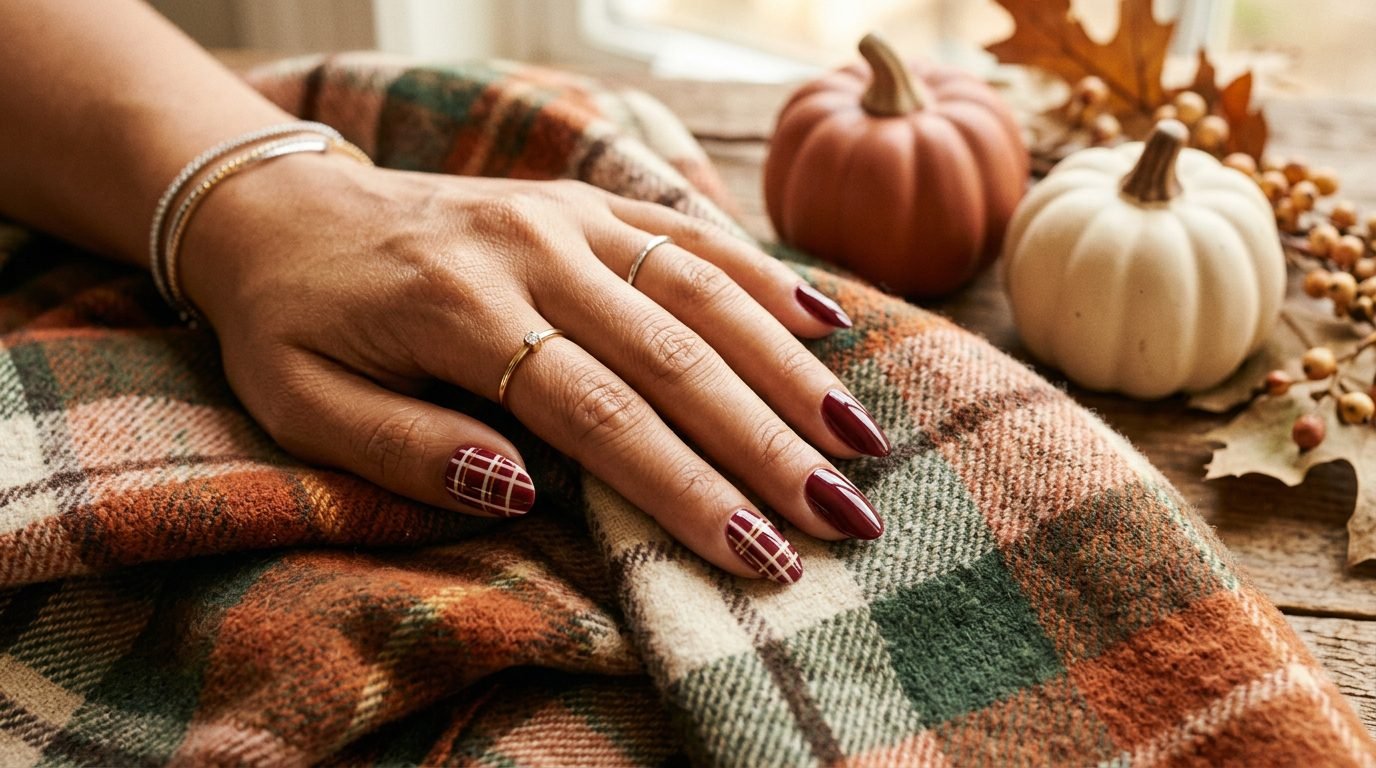
The build: paint the full nail in color one — burgundy is the season’s choice. Once dry, paint wide horizontal stripes in color two — cream or black — leaving equal gaps. Then wide vertical stripes in the same second color, crossing the horizontals. Where the two stripes cross, the color deepens naturally — that overlap IS the buffalo check effect.
The pro detail: real buffalo check has three tones where stripes cross — base, stripe, and the blended overlap. Let each vertical stripe dry slightly before the horizontal pass and the overlap stays crisp.
Colors that win: burgundy and cream — the Thanksgiving dinner pairing. Black and orange for the Halloween hangover weeks. Forest and cream for the tables that lean elegant.
Placement: buffalo check on ALL nails reads lumberjack-core. Two accent nails over solid burgundy reads polished. The accent version is what most people should do first.
Style 2: Classic Tartan — The Traditionalist

The proper Scottish plaid: a deep base, one wide stripe set, and a thin pinstripe set crossing at right angles, plus tiny accent dots at the intersections. The most refined plaid in the family.
The build: deep green base — forest is the Thanksgiving tartan standard. Thin horizontal stripes in burgundy, spaced wide. Thinner pinstripes in gold, running the same direction between the burgundy lines. Then repeat both vertically, crossing the horizontals. Finally, one tiny gold dot at each stripe intersection — the tartan signature.
The sequence matters: all horizontal lines first, fully dry, then all vertical. Wet-on-wet plaid smears into mud — the one fatal mistake in this entire guide.
Colors that win: forest, burgundy, and gold — the table-setting trinity. Navy, burgundy, and cream for the cooler-toned tables.
Placement: tartan on two accent nails over solid forest-green nails is the elegant Thanksgiving build. Full-hand tartan is the committed version — worth it for the family photo.
Style 3: Gingham — The Sweet Beginner

The picnic-check: evenly spaced thin lines in one color over a light base. The lightest plaid, the fastest build, and the most forgiving — gingham is where every first-timer should start.
The build: sheer or cream base. Thin horizontal lines in burgundy or copper, evenly spaced — three lines per nail. Then the same three lines vertically, crossing. The even grid IS the gingham.
The cheat that makes it perfect: striping tape. Lay three horizontal tapes, paint, peel; rotate, lay three vertical, paint, peel. Ruler-straight gingham on the first try, every time.
Colors that win: burgundy on cream — the sweetest Thanksgiving version. Copper on white for the modern table. Sage green on cream for the farmhouse aesthetic.
Placement: gingham reads best on one or two accent nails with solid warm nails around it. Full-hand gingham goes picnic-cute — right for casual gatherings, loud for formal tables.
Style 4: Blanket Plaid — The Cozy Artist

The pattern of the actual blanket — oversized, slightly irregular, built from thick soft stripes that do not apologize. The most artistic and most modern plaid in the family.
The build: cream or oat base. Thick irregular horizontal stripes in burgundy — not evenly spaced, deliberately loose. One or two thinner stripes in forest or camel crossing the same direction. Then one thick vertical stripe per nail in a third color, slightly off-center. The asymmetry is the design.
Why it works: blanket plaid mimics real woven wool — and real wool is never perfect. The slightly-off placement reads handmade in the boutique sense, and it is the most forgiving plaid for freehand painters.
Colors that win: cream, burgundy, camel, forest — the four-tone blanket palette. The exact colors of every November living room.
Placement: one blanket-plaid accent nail per hand over solid cream nails — the “wrapped in the blanket” manicure. This style also pairs beautifully with the cozy textures in our fall nail ideas 2026 guide.
Plaid Nails by Shape — Where the Pattern Sits Best

The same plaid changes personality across nail shapes, and two placements matter most.
Longer nails (almond, coffin): room for the full pattern — tartan with its dots and pinstripes needs this canvas. Vertical patterns elongate further here.
Short nails: scale the pattern DOWN. Buffalo check squares shrink, tartan drops its pinstripes, gingham keeps only two lines per direction. The pattern must fit the canvas or it reads cluttered — the same proportion rule that runs our short nail designs 2026 guide.
Square nails: the natural plaid home — the flat surface shows the grid crispest. Buffalo check was practically invented for this shape.
The accent strategy: whichever shape you have, two plaid accent nails over solid autumn shades is the universally flattering build — pattern enough to read, calm enough to live with for two weeks.
The Color Combos That Scream Thanksgiving

Four pairings cover every table this holiday.
Burgundy and cream — the official Thanksgiving plaid. Warm, traditional, flattering on every skin tone.
Forest, gold and burgundy — the full tartan trinity. The richest version, built for formal tables and the family photo.
Copper and oat — the modern warm neutral. For the tables that skip red entirely — this one whispers cozy instead of announcing it.
Black and orange — the late-October crossover plaid that carries from Halloween straight through November’s first week. The transition manicure when the holidays overlap.
Each pairing also matches shades already in our fall nail colors guide — pull the exact bottles from there, add nothing new.
How to Make Plaid Nails Survive the Holiday

Pattern work lives and dies by its topcoat — every raised line is a chip waiting for a chance.
Two topcoat layers, always. The first layer buries the line work; the second seals the edges. Plaid with one topcoat layer lifts at the stripes within days.
Wrap the tips. Every stripe that touches the free edge needs the topcoat cap across it — plaid chips start exactly where lines meet the tip.
Thin lines, full patience. Every stripe layer gets its dry time before the next direction crosses it — the wet-on-wet smear is unrecoverable, and it is the only mistake that forces a full redo. Build the plaid across an evening, not in one sitting.
And for the two-to-three-week marathon version, the gel systems in our gel nail designs 2026 guide hold line work far better than regular polish — with the removal in our how to remove gel polish guide keeping natural nails safe afterward.
Plaid Nail Mistakes to Skip

Three errors cause every “my plaid went wrong” story.
Wet-on-wet crossing. Painting vertical stripes over wet horizontals smears both into mud. Every direction gets its own dry time — this is the one rule with no exceptions.
Too many colors. Plaid uses two to three colors plus a base — four stripe colors on one nail reads noise, not tartan. The traditionalist builds stay under three.
Full-hand everything. Ten plaid nails compete with themselves. Two accents over solids reads boutique; ten accents reads wrapping paper. Restraint is the pattern’s best friend.
Thanksgiving Plaid Nails FAQ
Is plaid nail art hard to do?
It is the easiest “detailed-looking” design in existence — built entirely from straight lines with no curves or drawing talent required. Gingham with striping tape comes out ruler-straight on the first try, and buffalo check needs only wide stripes in two passes. The one real rule is letting each direction dry before the next crosses it.
What colors are best for Thanksgiving plaid nails?
Burgundy and cream is the official pairing, forest with gold and burgundy is the formal tartan trinity, and copper on oat is the modern neutral option. All three match the shades in our fall nail colors guide — no new purchases needed.
How do you paint plaid on nails without a striper brush?
A toothpick draws every line here — slower but fully capable. The real cheat is striping tape: lay it, paint over it, peel it, and every line is ruler-straight. Both methods appear throughout this guide’s builds.
Do plaid nails work on short nails?
Yes — with a scaled-down pattern. Gingham keeps two lines per direction, buffalo check shrinks its squares, and tartan drops its pinstripes. Two plaid accent nails over solid polish is the short-nail formula that reads proportional rather than cluttered.
How far before Thanksgiving should I paint plaid nails?
Three to five days before, with a two-layer topcoat and wrapped tips — plaid line work holds beautifully when sealed properly and carries you through the holiday weekend. Gel versions painted the weekend before last into December without a redo.
More questions? Ask us on Facebook and we will match a plaid style to your nail shape and your table.

Your Flannel, Miniaturized
Four plaid styles, one honest tool list, and the forgiving truth of the season’s coziest pattern — Thanksgiving plaid nails are the rare detailed design that beginners execute beautifully.
Pick your style tonight — gingham if you are starting, buffalo check if you are bold, tartan if you are traditional. Paint the accent nails this weekend, seal them well, and walk into Thanksgiving with the season’s coziest pattern at your fingertips.
Save this guide to our Pinterest boards so the patterns are on your phone when you paint, and complete the Thanksgiving shelf with our thanksgiving nail ideas, thanksgiving hairstyles, and thanksgiving makeup looks guides — the full holiday cluster.
New seasonal designs every week. Stay cozy, stay plaid! 🧣