
Wedding dress shopping has one question hiding inside every appointment — and almost nobody asks it directly.
“Which of all the wedding dress styles is actually right for me?”
The industry answers with emotions: “the dress chooses you,” “you will just know.” What the industry rarely explains is the architecture — that every wedding dress silhouette is an engineering decision, built to do specific things for specific bodies, venues, and seasons. A mermaid that stuns on one bride suffocates another. A ball gown that reads romantic in a ballroom reads overwhelming on a beach. The dress that “chose you” was actually the dress whose engineering matched your body and your venue — and that matching can be learned before the first appointment.
So this guide is the decoder. Every major wedding dress style explained — the silhouette, the body types it flatters, the venues it belongs in, the fabrics it needs, and the necklines that finish it. Read it before the first boutique visit, and you will walk in knowing what to ask for instead of hoping to recognize it when it appears.
The gown of your life starts with the vocabulary.
Follow our Pinterest boards for daily bridal inspiration, and join us on Facebook so you never miss a bridal guide.
The Silhouette Basics — The Words the Boutique Uses

The five words every appointment begins with — understood before the consultant says them.
Silhouette means the dress’s overall shape — how it flows from shoulder or waist to the floor. A-line, ball gown, mermaid, sheath, fit-and-flare — these are the silhouettes, and they are the first decision bigger than fabric or lace.
The neckline is the top edge — sweetheart, V-neck, off-shoulder, illusion. It shapes the face and décolletage and is chosen independently of the silhouette.
The train is the fabric that trails behind — chapel, cathedral, sweep. It is drama, logistics, and venue-matching in one decision.
Waistlines sit at natural, dropped, or empire heights — and changing the waistline changes the whole dress’s body logic.
Every style below is one silhouette paired with the necklines, fabrics, and bodies it serves best. The vocabulary first; the fitting second.
A-Line — The Universal Flatterer

The silhouette named for its shape: fitted through the bodice, flaring gently from the waist into an A shape at the floor.
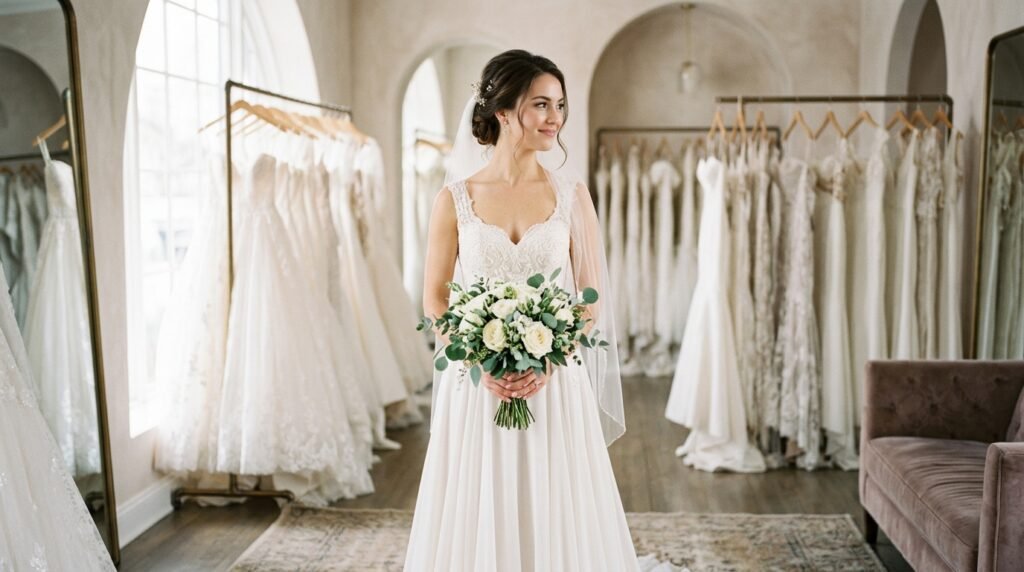
The body logic: the A-line skims the hips without hugging them — the waist gets defined, the hips get freedom, and the flare lands wherever the body’s proportions need it. It is the silhouette that flatters every body type genuinely, not as a marketing line — pear, apple, hourglass, athletic, plus size all find their version of the A-line.
The venue range: everything. Church, garden, ballroom, beach — the A-line is the silhouette with no venue enemy, which is why it remains the most-chosen wedding dress style in every market.
The fabric needs: the A-line holds structure in mikado and satin, flows romantically in chiffon and tulle, and reads modern in crepe. The fabric decides the A-line’s personality — structured princess or soft romantic.
The neckline partners: everything works — sweetheart for romance, V-neck for elongation, off-shoulder for the shoulder-line emphasis. The A-line’s versatility extends to its necklines.
Best for: every body type, every venue, first-time brides who want the safe-beautiful option, and anyone overwhelmed by choice — the A-line is the answer that never apologizes.
Ball Gown — The Fairy-Tale Volume

The princess silhouette — fitted bodice, dramatic full skirt from the natural waist, the volume that fills every ballroom.
The body logic: the ball gown hides everything below the waist by design — pear shapes, hip concerns, and anyone wanting the waist to be the story get exactly that. The fitted bodice defines the smallest point, and the skirt’s volume handles the rest.
The trade to know: the volume adds visual weight — petite brides get consumed by extreme ball gowns, and the skirt’s bulk is real logistics in bathrooms, cars, and dancing. The modern ball gown solves this with lighter tulle layers that keep the shape minus the weight.
The venue match: grand venues — ballrooms, cathedrals, estate lawns. The ball gown needs space the way a crown needs a head; beach and intimate venues swallow its drama or drown in it.
The fabric needs: tulle layers for the classic cloud, mikado for the structured architectural version, organza for the crisp romantic middle.
Best for: pear and apple shapes, formal grand venues, the bride who dreamed in princess her whole life, and winter weddings where the volume reads seasonal.
Mermaid — The Drama Statement

The silhouette that follows the body — fitted from chest through hips and knees, flaring dramatically at or below the knee.
The body logic: the mermaid is the hourglass celebration — it requires the body to be the dress’s structure, and it rewards curves by tracing them. Hourglass figures are its natural home; Athletic and rectangle shapes gain curves they can keep; apple shapes struggle because the midsection hug offers nowhere to hide.
The trade to know: the mermaid is the least forgiving and the most movement-restrictive — sitting, dancing, and the bathroom logistics all shrink. The modern fix: the mermaid flare starting slightly lower, or the stretch-crepe mermaids that move with the body.
The venue match: formal and glamorous — ballrooms, luxury hotels, evening weddings. The mermaid’s drama needs a stage; garden casualness reads mismatched.
The fabric needs: stretch crepe for movement, satin for structure and shine, lace over crepe for the textural version. Stiff fabrics fight the silhouette’s whole purpose.
Best for: hourglass and athletic shapes, confident brides, glamorous evening venues, and the weddings where the dress is the drama.
Sheath — The Minimalist’s Column

The straight silhouette — falling from the shoulders or neckline straight down the body, skimming rather than defining.
The body logic: the sheath does not sculpt; it flows. Athletic and rectangle bodies wear it as designed; hourglass bodies read their curves through the skim; pear shapes may want more definition than the column offers. The sheath is honest — it presents the body as it is.
The trade to know: the sheath offers no structural help — what the body shows, the dress shows. The shapewear conversation is a sheath conversation, and comfort with one’s frame is the entry requirement.
The venue match: the sheath’s natural homes — beaches, city halls, garden ceremonies, courthouse intimate weddings. The column reads modern-casual-elegant everywhere a ball gown reads wrong.
The fabric needs: soft crepe, silk, and bias-cut satins — the sheath is about drape, and drape lives in fluid fabrics. Structured fabrics turn the column into something boxier.
Best for: athletic and rectangle shapes, minimalist brides, beach and city venues, courthouse weddings, and second weddings where the drama has already happened once.
Fit-and-Flare — The Middle Path

The silhouette between mermaid and A-line — fitted through the bodice and hips, flaring from lower hip or mid-thigh.
The body logic: the fit-and-flare keeps the curve celebration of the mermaid while adding the movement freedom the mermaid lacks. Hourglasses get traced; pear shapes get hip-skimming before the flare; the flare’s starting point is adjustable to the body’s comfort.
The trade to know: the flare’s starting point is everything — too high reads babydoll, too low is just a mermaid. The right flare starts where the body wants freedom and the dress wants drama.
The venue match: everything from garden formal to ballroom — the fit-and-flare is the mermaid’s venue-flexible sibling.
The fabric needs: stretch crepe bodices with tulle or chiffon flares, or full lace over structured linings. The bodice-flare contrast is the design’s signature.
Best for: hourglass and pear shapes, brides who want the curve story with the dance floor plan, garden-formal and ballroom venues, and the indecision between mermaid and A-line — the fit-and-flare is the answer to that exact question.
Empire Waist — The Empire Line Legacy

The silhouette with the raised waistline — the seam sits just below the bust, and the fabric flows from there to the floor.
The body logic: the empire draws every eye to the narrowest point under the bust — small-busted brides gain dimension, apple shapes gain the waist-free flow, and pregnant brides get the silhouette designed for their journey. The empire is the dress that defines the bust and forgives everything below.
The trade to know: the long flow from under-bust can read maternity on non-pregnant bodies if the fabric clings — the empire needs flowy fabrics to read elegant rather than expecting.
The venue match: garden and destination weddings, summer ceremonies, and the romantic outdoor settings where the empire’s flow reads seasonal.
The fabric needs: chiffon, silk, and soft tulle — the empire’s whole logic is flow, and the fabric must deliver it from the highest seam in the dress.
Best for: apple shapes, small busts wanting dimension, pregnant brides, summer and destination weddings, and the regency-romantic aesthetic brides.
Trumpet — The Mermaid’s Gentler Sibling

Often confused with the mermaid — the trumpet fits closer through the body but flares gradually from mid-thigh, the flare arriving softly rather than dramatically.
The body logic: the trumpet traces like the mermaid but forgives like the fit-and-flare — the gradual flare is the movement-friendly version of the drama. Hourglasses and athletic-curvy builds are its home.
The venue match: identical to mermaid — formal, glamorous, evening. The trumpet reads mermaid-adjacent at every venue, with slightly more dance floor freedom.
Best for: hourglass shapes wanting mermaid drama with A-line comfort, and the brides torn between the two — the trumpet is the compromise that doesn’t feel like one.
Teagown and Drop Waist — The Vintage Lines
The silhouettes of the 1920s and the romantic revival — the drop waist seams at the hips, the loose teagown flows.
The body logic: the drop waist elongates torsos and reads vintage on every body — the 1920s straight-line logic, modernized. Rectangle and athletic shapes suit the drop waist naturally; hourglasses trade their waist definition for the era’s aesthetic.
The venue match: vintage-themed weddings, art-deco venues, and the garden parties where the era reads charming rather than dated.
Best for: the era-specific brides, rectangle shapes, and the weddings where vintage is the venue’s whole language.
The Neckline Decoder — The Top Decision

The silhouette decides the body; the neckline decides the face. Seven necklines, seven effects.
Sweetheart — the heart-shaped neckline, the romantic standard. Flatters every bust size, reads feminine on every silhouette. The default that rarely fails.
V-Neck — the elongator. Deep and shallow versions; the vertical line that lengthens the neck and torso — the neckline for petite brides and fuller busts alike.
Off-the-Shoulder — the shoulder-baring romantic. Flatters athletic shoulders, balances pear shapes by widening the top line, and reads universally romantic. The arms get their moment; the strapless bra conversation happens.
Illusion — the sheer tulle panel with embroidery — the neckline that reads covered and bare at once. The choice of the modest-bride, the conservative-venue bride, and the bride who wants the detail shot.
Bateau — the wide, low curve following the collarbone. The elegant, the French, the neckline of the minimalist column dresses.
Square — the structured frame — flatters fuller busts, reads modern in minimal dresses, and photographs symmetrically.
Halter and High Neck — the shoulder-framing options — halter for athletic shoulders, high-neck for the modest and the vintage-inclined. Both read intentional in a strapless world.
The Train Decoder — Chapel, Cathedral, Sweep

The train is the drama decision — and the venue decides it.
Sweep train — the shortest, brushing the floor behind. The beach and courthouse train — removable drama, minimal logistics.
Chapel train — the standard — about a foot of trail. The garden and ballroom default; dramatic in photos, manageable in movement.
Cathedral train — the three-to-six-foot statement. The cathedral and ballroom train — the aisle photos that become the album’s cover, and the bustle conversation that follows every reception.
The detachable option: the detachable train overlays — cathedral drama for the ceremony, sweep freedom for the reception. The modern solution to the drama-versus-dance-floor conflict.
The Fabric Decoder — What the Dress Is Made Of

Six fabrics carry every style above — each with its personality.
Satin — the structured shine. Holds ball gowns and mermaids in architectural shapes, photographs with a sheen, reads formal.
Crepe — the modern matte. Falls close, moves with the body, reads minimalist — the sheath and mermaid’s favorite.
Tulle — the cloud maker. Ball gown volume, veils, and the layered romance that photographs ethereal.
Chiffon — the soft flow. Empire lines, A-line romance, and the beach-wedding weightlessness.
Lace — the texture story. Overlay on everything, from full-lace gowns to lace appliqués — the fabric that reads tradition, romance, and family.
Mikado — the heavy silk. The architectural A-lines and ball gowns — the fabric that holds volume without twenty tulle layers.
The Body-Type Quick Map — The One-Page Answer

The guide compressed to one decision map — find your body, read your silhouettes.
Hourglass: mermaid, trumpet, fit-and-flare — the curves are the dress’s structure. Skip shapeless sheaths that hide the waist’s whole story.
Pear: A-line, ball gown, empire — the hip-freedom silhouettes. The fitted bodice defines the waist; the flare handles below.
Apple: empire, A-line, fit-and-flare with structure — the waist-forgiving silhouettes with defined busts. V-necks elongate; avoid belt-emphasized natural waistlines.
Athletic/Rectangle: sheath, mermaid, fit-and-flare with detail — the silhouettes that add curve where the body is straight. Sweetheart necklines and ball-gown skirts add dimension where wanted.
Petite: sheath, A-line, trumpet — the clean lines that elongate. Skip extreme ball gown volume that consumes smaller frames; the neckline’s V is the petite bride’s best friend.
Full bust: V-neck, sweetheart with structure, bateau — the supportive necklines. Strapless demands internal architecture; the illusion neckline distributes beautifully.
Plus size: every silhouette in the right fabric — structured A-lines, crepe mermaids, tulle ball gowns. The fabric list above matters more than the silhouette list; the supportive construction is the real fit secret. The body-positive principles from our plus size thanksgiving outfit guide apply to gowns identically — the architecture, not the size, makes the dress.
The Venue Decoder — Dress Meets Place

The silhouette-venue matching table — the decision the boutique cannot make for you.
Beach: sheath, empire, soft A-line in chiffon — the wind-friendly, sand-friendly family. Skip cathedral trains and heavy mikado.
Ballroom: ball gown, mermaid, cathedral-train A-line — the grand silhouettes for grand rooms. The venue rewards every drama.
Garden: A-line, fit-and-flare, empire in soft fabrics — the romantic flow family. Structured volumes fight the garden’s informality.
Church/cathedral: every silhouette welcomes — the tradition venue that hosts ball gowns and columns equally. The train decision is the only real choice here.
City hall/courthouse: sheath, short A-line, tailored columns — the intimate venues that reward modern minimalism. The drama stays in the photos, not the logistics.
Estate/mansion: ball gowns, A-lines, and the vintage lines — the venue that hosts every era’s silhouette with architectural agreement.
The Appointment Strategy — Shopping With the Vocabulary

The guide’s payoff — how the decoded vocabulary changes the boutique visit.
The three-silhouette plan: book the appointment with three silhouettes to try — the guide’s match, the wild-card, and the consultant’s suggestion. Three lanes, no overwhelm.
The vocabulary power: “A-line in crepe with a sweetheart neckline” gets a different appointment than “something pretty” — the decoded bride sees exactly what she asked for, and the consultant curates instead of exploring.
The team rule: two people maximum in the appointment — every additional opinion multiplies the confusion the vocabulary just solved. The bride’s voice is the loudest in a room of two.
The body-truth note: every boutique carries limited sizes of samples — the dress that fits the sample size in the room is not the only dress that exists. The order-size conversation is its own science, and the bride who knows her silhouettes navigates the sample-size reality with composure.
Finish the bridal education with the supporting pieces — the veil and accessory pairing from our bridal hair accessories guide, the makeup artistry in our bridal makeup guide, and the hair architecture in our wedding hairstyles guide — the dress is the centerpiece; the bride is the exhibition.
Wedding Dress Style FAQ
What wedding dress style is most flattering?
A-line is the honest answer — it flatters every body type genuinely by skimming hips and defining waists, and it suits every venue from beach to ballroom. The flattering silhouette for a specific body: hourglasses own mermaids, pears own A-lines and ball gowns, apples own empires, and athletic frames wear sheaths as designed.
What is the difference between mermaid and trumpet?
The flare’s arrival — mermaid flares dramatically at or below the knee, while trumpet flares gradually from mid-thigh. Mermaid is the drama; trumpet is the same curve story with dance-floor freedom. The fit through the body is nearly identical.
Which wedding dress style suits a pear-shaped body?
A-line and ball gown — both define the waist and free the hips from definition duty. The fitted bodice creates the upper anchor, and the flare handles the lower half. Empire waists work too, drawing the eye to the bust line.
How do I choose a wedding dress for my venue?
Match the silhouette’s drama to the room’s scale — ballrooms reward ball gowns and cathedral trains, beaches reward sheaths and chiffon flows, gardens reward A-lines and fit-and-flares, and intimate venues reward columns. The dress that harmonizes with the venue photographs as one composition.
How many dress styles should I try at my first appointment?
Three silhouettes minimum — your guide-matched style, one wild-card silhouette you would never pick, and the consultant’s suggestion. The wild card is how brides discover the dress that “chose them” — it is usually the silhouette the vocabulary led them to, not away from.
More questions? Ask us on Facebook and we will help you decode your silhouette before the first appointment.

The Vocabulary Was the Answer
Seven silhouettes, seven necklines, six fabrics, and the maps that connect them to bodies and venues — the wedding dress style guide that turns “the dress chooses you” into “you knew exactly what to ask for.”
Study the decoder before the appointment. Build the three-silhouette plan. Walk into the boutique speaking the language — and watch the consultant’s eyes change, because the bride who knows her silhouettes finds her dress in three appointments instead of ten.
Save this decoder to our Pinterest boards so it travels to every appointment, and complete the bridal file with the bridal hair accessories, bridal makeup guide, and wedding hairstyles guide — the dress decoded, the bride complete.
New bridal guides every week. Stay decoded, stay radiant! 👰